


As time progresses, one appears to witness an advancement in the progress of science. Cosmology, medicine, mathematics, metallurgy, and knowledge are just a few branches of science that has experienced a radical change only in the last few centuries. Yet, in that scientific progress, one may witness a halt or a depression in that field, often based on the social frameworks of the time. Religion, politics, war, and more elements tie into the cause, and one realizes that science is not a steady progress, but a jagged and fragmented one.
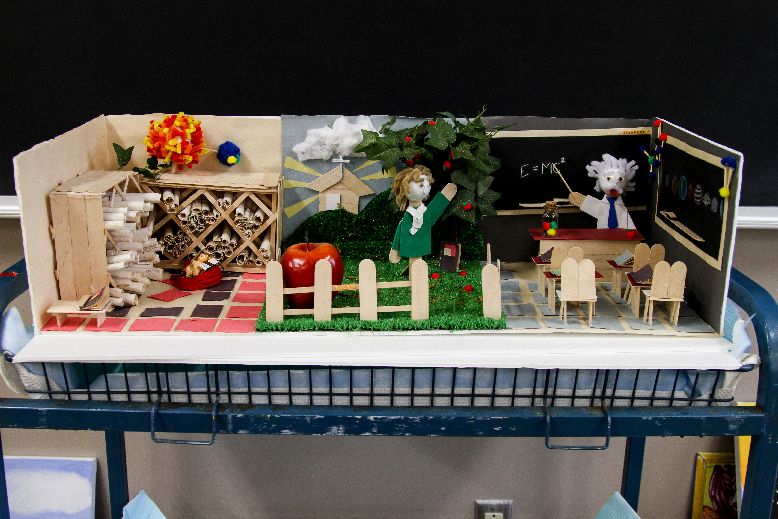
The first element of the maquette is a small-scaled version of the library of Alexandria. The library is meant to represent the embodiment of knowledge that was present in the Hellenic era, most importantly the later Greek, Roman Republic and its latter empire. While it may seem Western and occidental, the Library of Alexandria was renowned for its important collection of documents and books from the Far East and from the southern civilizations of the Indus Valley. Scholars would rally in Alexandria and share the knowledge from all corners of the world, and make new discoveries in the world of mathematics. Yet, this progress went to a halt when the rise of a new sect of Judaism, Christianity, gained a foothold in the Roman Empire. The backward views and strict rules compared to the Greco-Roman religion clashed with the advancement in cosmology, which created uproar and the inevitable purging of the biggest library of the time, and all the accumulated knowledge it held. Hence the depiction of baby Jesus with the cross made out of matches; it was only a question of time before it would go ablaze.
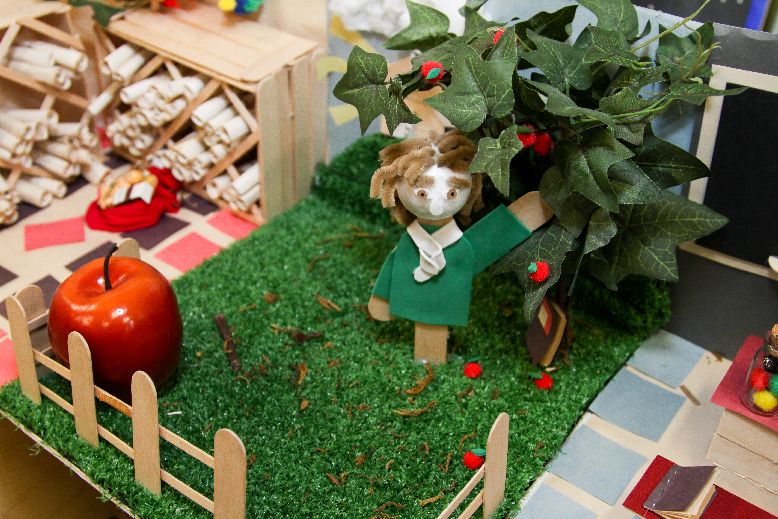
The second portion of the maquette jumps a millennium into the future, up to the period of the Enlightenment. In the foreground, we witness Isaac Newton's discovery of gravity, which is represented with the apple tree and the enlarged apple in the closer foreground. In the background, we can see a church, but compared to the last thousand years, it is not the centre of the attention, but an intelligent human being. The humanist ideals of the renaissance are echoed in the Enlightenment, giving more importance to man than the church. This is one of the key points of the scientific revolution, since the advancement of science was halted under both the holy cross the crescent, with concepts such as the heliocentric solar system long lost in the smoke and ash of Alexandria. As religion loses a foothold in politics, we experience a reawakening of ancient science and mathematics now rediscovered, which allowed individuals such as Newton to publish his works without persecution and fear. With religion now aside, human beings are challenged by science to try to understand the big beginning, albeit conceived by a god or otherwise.
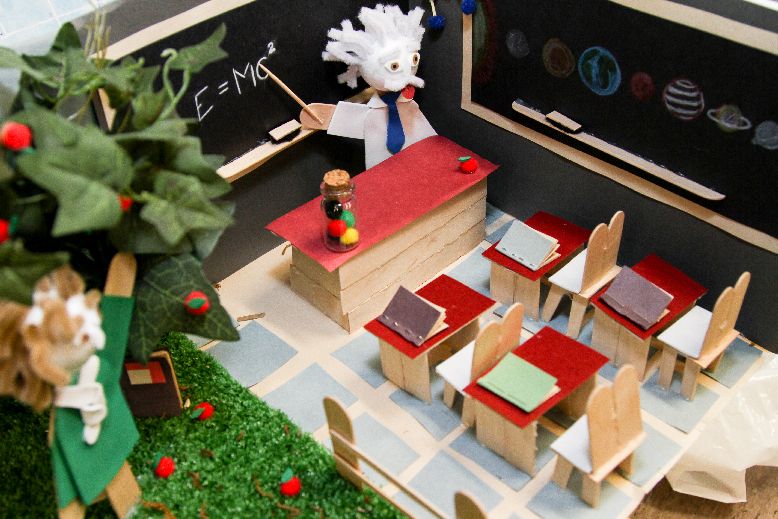
The third part of the maquette represents what we are today, which is the endless quest to further understand the cosmos, and its beginning. Of course, with no considerable elements to halt the dream to completely understand the universe, we can witness a radical change of ideology in a span of just a few years. A vital element for this, which is the implementation of science to the general public, allowed for this remarkable advancement in cosmological understanding in such a short span of time. The concept here was to show the contrast between the ancient ways of learning compared to now, especially the availability of that education to the most underprivileged. All in all, the concept of the heliocentric model is written in stone, but what inspires us to pursue astronomy is beyond our solar system, even our galaxy.