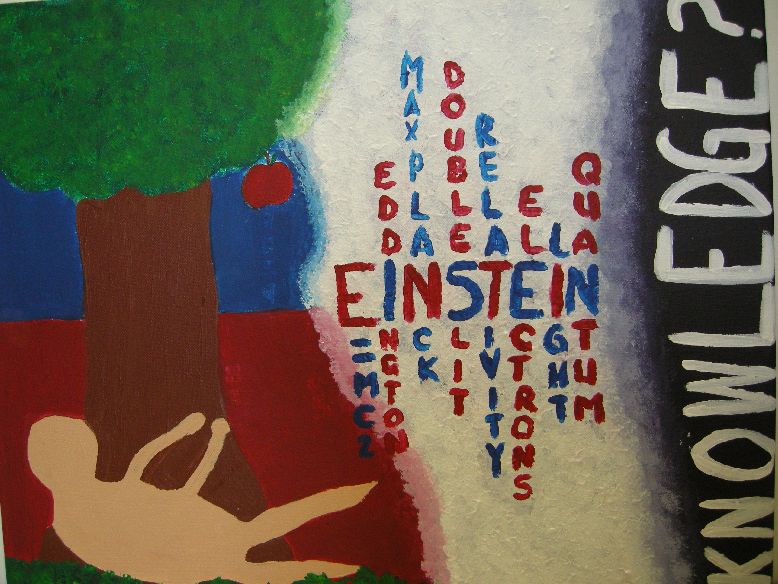


My sketches of the painting I hoped to create underwent various changes which made the final product, I think, that much better. This painting is actually based on a postmodern concept which I learned in Modernism and Postmodernism, which was the idea that science, like religion, is essentially a grand narrative. This similarity between religion and science prompted me to look for other connections, and I came upon several icons that where important both to science and religion.
Having adored Michelangelo’s Creation of Adam for quite some time, I knew instinctively that I wanted to base my painting on his own. I chose to imitate the placement of images in the painting by positioning my own images in a similar pose. However, instead of having God reaching out to Adam, I chose to incorporate the word “Einstein” and had other words important to Quantum Theory such as “Relativity” and “Electrons” branching out of the letters of “Einstein”. At the end of the word “Einstein”, I replaced the figure of God with the word “Knowledge” in order to demonstrate that humans are reaching for knowledge through scientists where they once looked to religious leaders.
I also noticed the importance that both belief systems attributed to the actions of an individual. The Christian faith held up the first man, Adam and the Messiah, Jesus Christ in a particularly high regard just as scientists worshipped the work of Sir Isaac Newton and Albert Einstein. Therefore, I deliberately painted an ambiguous man who could either represent Adam in the Garden of Eden or Sir Isaac Newton sitting beneath his famed tree. The human figure, whether Adam or Newton, is reaching for knowledge in its own particular way, and this is representative of one of the common threads between religion and science. They are both different ways to garner knowledge about the world in which we live in.
The next thing I noticed was that the icon of the tree came up fairly often. The Tree of Knowledge, which was rumored to contain all the knowledge in the world, is in the Garden of Eden according to the creation story in the Old Testament. The tree is also an important figure in Bishop Berkeley’s philosophy and is arguably one of the best-known philosophical paradoxes today. Bishop Berkeley’s philosophical standpoint is often referred to as the pre-cursor to Einstein’s Theory of Relativity and this thought experiment resonates with traces of what would become Quantum theory. The Bishop argued that if a tree fell in a forest, and no one was there to witness it, could we really argue that it had fallen or that it even existed in the first place? Bishop Berkeley argued that the observer shaped reality and determined what was real and what was not, however he factored God into the equation and explained that since God was constantly observing the world, then the tree would have been seen by God and must therefore exist. If one were to ignore the conclusion which the Bishop came to, then one would be able to clearly see Quantum theory in the emphasis that Berkeley placed on the observer and the relativity of reality. This connection caused me to incorporate a tree which represented both the Tree of Knowledge as well as Bishop Berkeley’s Tree of Existence.
The apple hanging from the aforementioned tree also has a dual role in both science and religion. Religiously speaking, the apple is a representation of the forbidden fruit which Adam and Eve chose to bite into and are kicked out of the Garden of Eden as a result, however the red apple is also a representation of the apple that supposedly hit Newton on his head and, as legend has it, allowed him to put together his theory of gravity.
The red and blue backgrounds which are clearly separated represent space and time as they were viewed by Newtonian scientists up until Einstein and Eddington proved otherwise. When the two colors meet the word “Einstein” in the painting, there is a murky, uneven off-white background which demonstrates how unclear and chaotic Quantum Theory is, and once the word is complete the background fades into a deep purple, which represents the relationship between space and time. Thanks to Einstein’s work, scientists now understand that space and time are not two separate entities but in fact tied together so tightly that to influence one is to affect the other.
As one can see, this painting is a very ambiguous one that can be interpreted in several different ways, and it was deliberately fashioned in such a manner. By doing so, it not only demonstrates the concept of parallel universes and different possible outcomes of the same scenario, but is also self-reflective and forces the viewer to realize that the interpretation of the painting depends entirely on the viewer. Each viewer will see something different in the painting, and that relativity is, I think, the true heart of Quantum Theory.