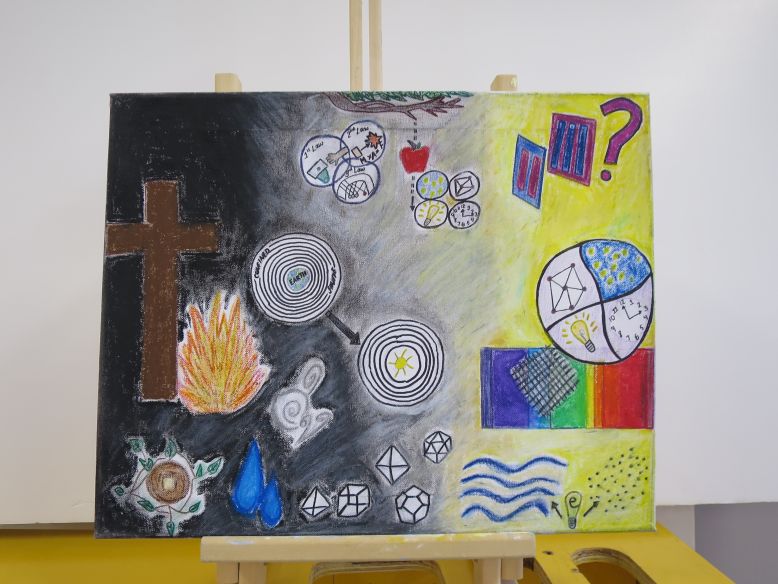


Throughout history, we have seen that most evolution is progressive. This is especially true with regards to science as many scientists continue what their predecessors started. Some scientists make such an impactful contribution, that their names are used to term different worldviews or cosmologies. In the course, we were exposed to Aristotelian, Newtonian and Twentieth century cosmology. There were important contributions made to science in each cosmology. Therefore, I essentially tried to illustrate our entire course onto a canvas! I wanted to split my canvas into three sections to represents the three cosmologies tackled in class. I began with Aristotelian, a period known for being centered on common sense. Although, there were many discoveries in this worldview, the most prominent element illustrated on my canvas was a brown cross. Firstly, it is painted brown as I attempted to depict a wooden cross. Secondly, the cross is there to depict the influence of the church and religion in this worldview. I was influenced in by The Name of the Rose, where the movie focused on the negative power and manipulation of the church. It is a fact that religion and science do not tend have a progressive relationship. This is why the background of the cross is very dark (black); it represents the darkness people lived in prior to and during Aristotelian cosmology. This was especially the case for those who did not accept science as a possible explanation for things in the world. In Aristotelian worldview, Empedocles suggested that all matter was made up of the four elements: water, earth, air and fire. He considered this the world’s “roots”, therefore, I thought it pertinent to include the four elements in my artwork, as I saw this as the beginning of scientific (or natural philosophical) thinking. If you look closely behind my sketch of the four elements, you’ll see the black background a little lighter than it was behind the cross. This was meant to represent the beginning of progress. The same pattern (the background) continues behind the platonic solids which was the next feature I included for Aristotelian cosmology. There are five platonic solids: the cube, tetrahedron, octahedron, icosahedron and dodecahedron. They were a continuation of Empedocles’ notion behind the four elements, where all other substances in the universe were said to be derived from the platonic solids. I then included Ptolemy’s geocentric model (with epicycles[j1]), as it was a universally accepted model of the universe’s function. It was also meant to represent what was believed by many natural philosophers about the universe (prior to Ptolemy), before the Scientific Revolution. This model served as the predominant cosmological system in many ancient civilizations like ancient Greece. The belief that the earth was at the center of the universe was the initial explanation for the universes function, and was a sort of stepping stone for 16th century scientists like Nicholas Copernicus (during the Scientific Revolution) to search for other possibilities. The geocentric model was later replaced by the heliocentric model which illustrates the sun at the center of the universe, not the earth. I wanted to depict this in my artwork as it shows science as a process, but one where progress does occur. That is why the background behind the heliocentric model is a lighter than that of the geocentric model, to exemplify advancement. Following Aristotelian cosmology was Newtonian cosmology. Therefore, I wanted to depict the same thing in my artwork! In addition to the heliocentric model, I included many of Isaac Newton’s contributions to science. The worldview is entitled Newtonian cosmology; therefore, Newton did play a major role. I began by depicting his famous apple to explain gravity, as Newton is most recognized by this symbol. There are then three bubbles where his three laws of motions were illustrated: His law of inertia (which I depicted by a hand trying to pull a paper with a coin on top, off a cup), F=m × a (force is equivalent to mass times acceleration, and lastly his law of opposing forces (depicted by Newton’s cradle) I then included the concepts of space (depicted by stars and a sky), time (depicted by a clock), energy( depicted by a light bulb) and matter (depicted by lines and circles). They were believed to be separate from each other in Newtonian cosmology therefore, I illustrated them separately.
Twentieth century cosmology was a worldview filled with scientific advancements or as I like to call it enlightenment! I viewed this metaphorically as a time of complete brightness and brilliance, hence, the yellow background. One of the most prominent features of my artwork is the electromagnetic spectrum which was an important contribution from this worldview. It represents the notion of quantum or in this case, quantized colors as they only exist at specific levels[j2]. In addition, quantum theory explains that interference occurs through observation[j3]. This can be seen through the double-slit experiment where the electrons acted differently when they were observed. It also demonstrates the principle of uncertainty as our perception can no longer be simply based on common sense. The “common sensical” outcome of the double-slit experiment (the electrons passing through two slits would ultimately form two slits on is back wall) did not occur. Instead, there was an unexpected outcome (electrons passed through two slits, and a third slit was formed on the back wall[j4]) which illustrates that uncertainty. I depicted the uncertainty though a large question mark which I drew next to my sketch of the double-slit experiment. However, uncertainty can also be interpreted from sketch of wave-particle-duality, as light can act as both a wave and particle depending on the experiment set-up. I depicted this to show progress from Newtonian cosmology where many scientists debated theories of the propagation of light. However, it was in twentieth cosmology where Einstein proposed (through the photo-electric effect) that light could in fact act as both. As Einstein played a major role in twentieth century scientific advancement, I included a few more of his contributions in my artwork. I included a depiction of his general theory of relativity. I did this by connecting the concepts of space, time, energy and matter which were previously seen in Newtonian cosmology. However, unlike Newton who believed they were separate entities, Einstein’s notion of relativity is what connected them all. Therefore, like most advancements made in science, we see that ancient discoveries serve as the foundation for new discoveries, like that Einstein’s general theory of relativity, which I depicted through a large circle split in four (one section for each entity: space, time, energy, matter). Finally, right under the circle, hidden in the electromagnetic spectrum, I included the commonly used space-time sketch to illustrate the relationship between space and time, discovered by Einstein. Science will always be process, my artwork was meant to represent the transitions of this process and to illustrate the multiple contributions from each worldview. We started off with darkness and are made our way to enlightenment!